
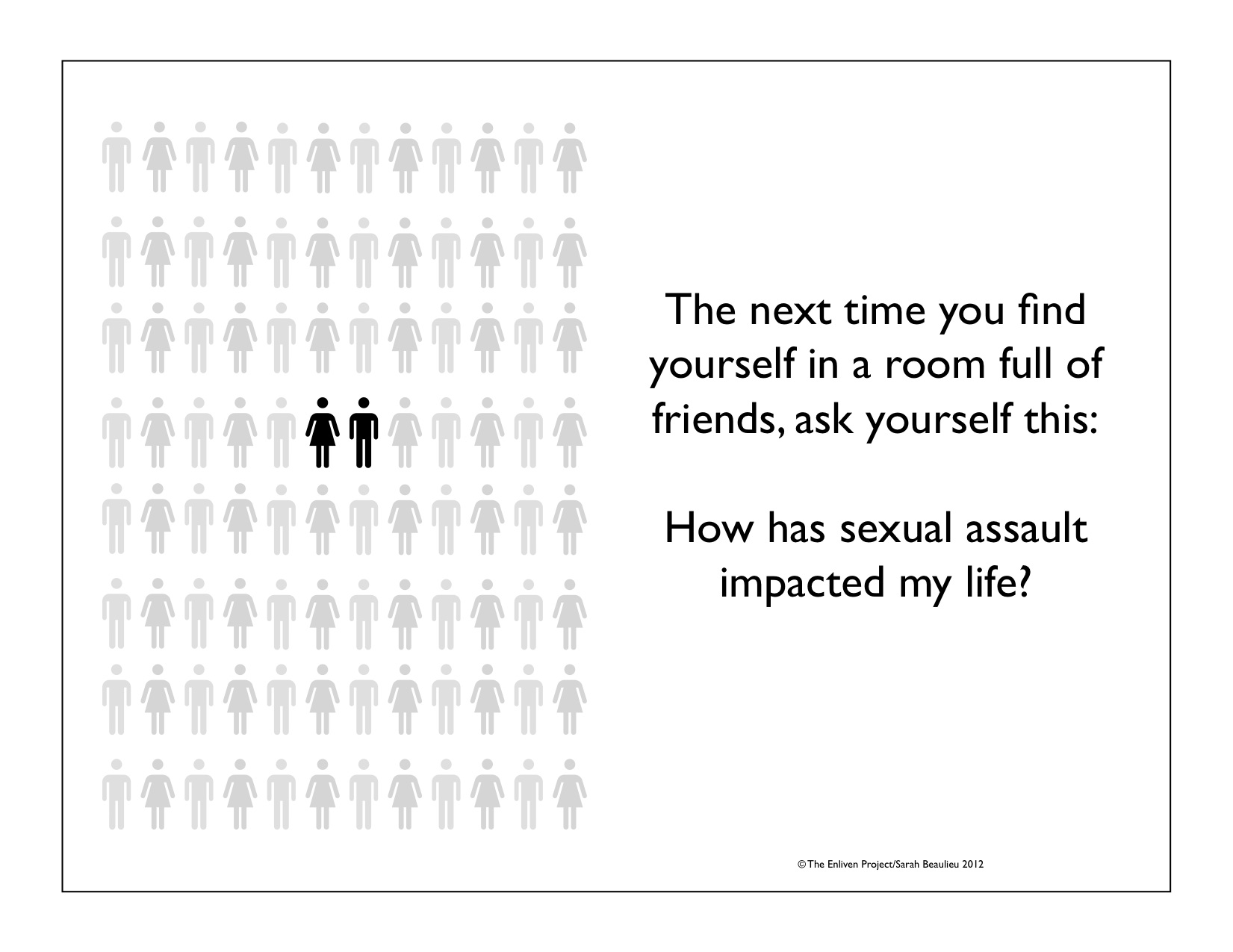
Welcome to the conversation. It’s so nice that we are finally having one. Before this week, I was just a woman with a regular day job, a wife, a mom, a friend, and a casual writer on a blog that I shared with my friends. But I believed deeply that the world needed to have more honest and compassionate conversations about the things that really matter in our lives. So I started sharing my thoughts and perspectives publicly. Sometimes in provocative ways. And somehow, accidentally, I found myself in the middle of controversy, watching an infographic my brother and I made go viral overnight. Tens of thousands of people shared it on Facebook and Twitter, re-blogged it on Tumblr, debated it, loved it, and hated it. The intention of this graphic was to spark a conversation about how we experience the fear of false accusation of rape as greater than it is in comparison to the problem of rape and sexual violence. The data behind it has been critiqued, both fairly and unfairly. And I’ve listened and learned. But we started a conversation, and an important one at that. Sexual violence is the biggest issue we aren’t talking about in America. You don’t have to look to Steubenville or Brooklyn or India to find stories about sexual violence. You just need to look around the table at your next staff meeting, classroom discussion, or family dinner to find stories of direct and indirect impact. 16-25% of Americans will be sexually assaulted in their lifetimes. Yup, that’s 1 out of 6 men and 1 out of 4 women. If you don’t know someone who has been directly impacted, you either don’t know very many people or [...]
The Story Behind the Infographic
As a wife, mom, survivor, and regular person until Monday morning, I am overwhelmed and astounded by the reaction and response to the “Truth About False Accusation” infographic, and encouraged by the dialogue that has emerged as a result of it. Thank you to each and every person who shared it, debated it, loved it, and hated it. We accept and encourage debate on this and any future infographics released by The Enliven Project. Given the massive amount of media coverage and online discussion about it, I wanted to provide some additional – and more well-thought out – context to the purpose of the graphic and The Enliven Project, as well as to address a bit of criticism about the data we used. The purpose of this graphic is to compare (primarily men’s) fear of being falsely accused of being a rapist to the many challenges around reporting, prosecuting, and punishing rapists. Two key figures drive that point home: A reporting rate of 10% A false reporting rate of 2% The other decision we made was to present data that fell within documented ranges, rather than reflect the findings of a particular report, because of the inherent challenge in collecting data on this issue. Said another way: at the moment, an argument could be made that every source is flawed in some way. The reason we pursued a composite approach instead of relying on one study was exactly to spark discussion about the underlying data and definitions, and – perhaps most importantly - the current challenges in data collection. For example – here are a handful of challenges that we encountered while putting together the infographic and, as a result, some limitations of the infographic [...]
The Challenge of Data
One of the key challenges about sexual assault statistics is that it’s nearly impossible to gather accurate and consistent data about incidence and prevalence. This infographic doesn’t do a perfect job, but it combines data from several sources, both domestic and international. Particularly with sexual violence, the shame and stigma associated with the issue is so significant that it’s hard to count what isn’t being reported. Think about erectile dysfunction. Ten years ago, it would have been impossible to know how many people were suffering from erectile dysfunction. Now that there is a cure, a successful pathway to recovery, people are comfortable talking about it to their doctors and we have much more accurate figures. The purpose of the illustration – and of The Enliven Project – is to provoke new kinds of conversations about sexual violence. We hope that you have been inspired to have deeper conversations about sexual violence because of what you have seen and read here. For those of you who have asked, here is the background on the stats we used: Some reports suggest that only 5-25% of rapes are reported to authorities. Other suggest that close to half are reported. We assumed 10%, which is dramatic, but possible. Of the rapes that are reported, approximately 9 are prosecuted. Of the prosecuted, 5 result in felony convictions. This is across the board for all felony prosecutions, not just rape. Assuming that 2% of reported rapes are false and a 10% reporting rate, the graphic assumes that 2 of 1000 rapes are falsely reported (assuming a rape can’t be falsely reported unless it’s reported in the first place) If you have other stats you would like to share, please leave them in comments. Thank you!
-
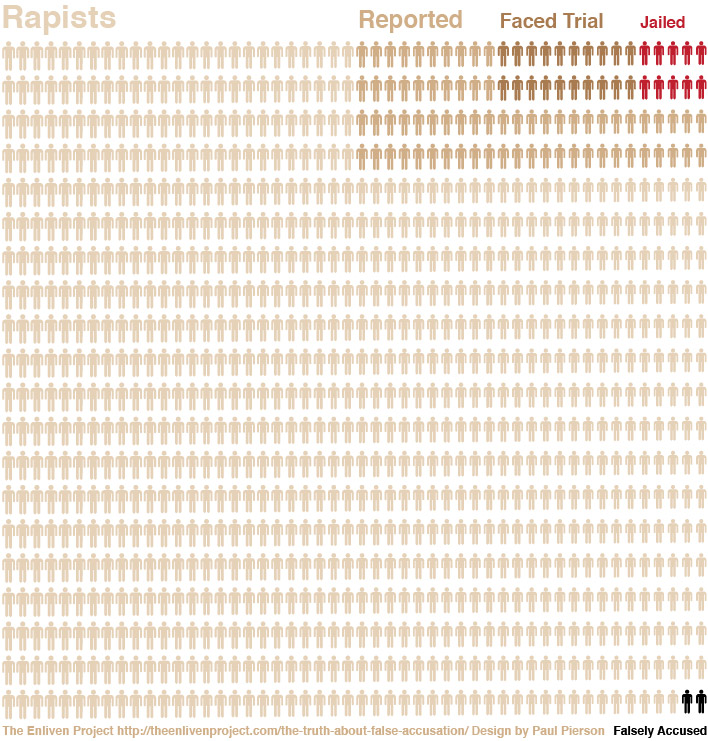


The truth about false accusation
Warning: Creating default object from empty value in /homepages/28/d358518096/htdocs/wp-content/themes/Avada/new-slideshow.php on line 132
The truth about false accusation
The fear of getting falsely accused of rape just doesn’t compare to the fear of an actual rapist getting away with his or her crime. Statistics from Justice Department, National Crime Victimization Survey: 2006-2010 and FBI reports. NOTE (1/7/13): For more detail on statistics used, please click here.
Consent
Trigger Warning: This post contains a personal story about rape. I was 17 and he was my friend. We were having sex - my first time - and I wanted to stop. I said, Can we stop? He said, But I didn’t come yet. I said, But it really hurts. Silence. He was on top. He was bigger. He continued until he was finished. I stared at the ceiling. When he was done, he told me he thought it was great - that I was great. He got dressed. I got dressed. He kissed me goodbye. I was 17 and he was my friend. I wrote this post over and over again, and was conflicted about publishing it. It feels messy and complicated even 15 years later. I invited him over to my house with the intention of having sex. I invited him up to my room, put on some music, and happily made out with him. We got undressed together. He asked if we could have sex and I said yes. But in that one moment when I asked to stop, it all changed. In that one moment, it went from two teenagers messing around to one person deliberately hurting another person. What happened to me hurt me in that moment - physically, emotionally, and mentally. The physical hurt was brief but the emotional and mental damage lasted for many years after that. In the end, was it bad sex or rape? For years, I thought it was just sex - not even bad sex. I thought that once I said yes, it meant yes to everything and everything was defined on the other person’s terms. It didn’t matter if it hurt me or I didn’t want to do it. I thought there was no [...]
Heartspoken: You Already Survived
Thank you to So Lucky To Be Me Tees for providing the gear for this shoot - and a powerful message of hope and strength for women!
Like Peanut Butter: Finding My Path
“You understand yourself so well, why are you here?” It was the beginning of my freshman year of college when the therapist I had been seeing for a couple of months asked me this question. I was silent for a moment and finally responded, “Because I can’t stop hurting myself.” It was true. Since I arrived on campus, I was on a downward spiral of starving, purging, over-exercising, drinking, and cutting. The cycle started Monday morning when I woke up promising to be good for the week by sticking to my “diet” of 750 calories per day and working out at least once a day if not twice. I’d usually make it until Wednesday, maybe Thursday, when I’d fall off the wagon with a bowl of pasta or slice of pizza at a study night. Angry at myself, the slip would turn into a night of drinking, resulting in more feelings of self-hatred, shame, and despair. And then I’d wake up and start the cycle all over again. I was drinking 12 cups of coffee a day to keep myself going, and had a full class load and busy college schedule. The therapist was right though. I did know exactly what I was doing and why I was doing it - I knew that controlling my body and what went into it was about being sexually assaulted. I knew that cutting myself was a distorted way of feeling something real. But talking about it didn’t seem to help. It was like I could hear myself telling her these things and hear them at the same time. I was scared but I didn’t know what to do. I knew this woman couldn’t help me. Luckily, [...]
The First Time I Told Anyone
I’ve referenced telling my story for BARCC in previous posts but haven’t actually told it here. This is the 5-minute version I tell at speaking engagements. Obviously, condensing a 25-year journey into 5 minutes is no easy challenge, but here it is: When I was eleven, my parents, brother, and I went to visit my grandparents in Oregon. I loved visiting my grandparents. My grandmother was full of energy and creativity - we would wake up early and go pick blackberries by the ocean, talking about life and sharing stories. My grandfather was somewhat of a mystery to me, but I had great affection for him, especially because he was sick with Parkinson’s disease. On that trip however, in the summer of 1988, my grandparents molested me. My grandfather felt my breasts while my parents and brother were out for a walk. And my grandmother took a bath with me where she touched me Inappropriately. Now, this wasn’t the first time I was sexually assaulted nor would it be the last time, but it was the first time I told anyone. That night, I told my mom what had happened and I remember that all the color drained from her face. I thought she was mad at me, and I felt scared about what was going to happen. She left the room, and I heard lots of talking and whispering. The next day, my dad sat my grandfather down for a talk. I heard muffled, intense voices. And then we stayed the rest of our visit. When we went home, everything went back to normal. Except I didn’t feel normal at all. Over the course of the next six years, I just felt worse and worse. I tried to cope with my feelings the best way I could, but I was just a kid. [...]
-
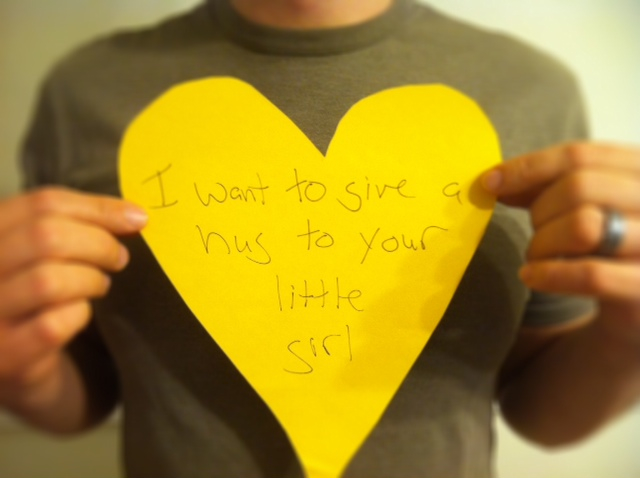
Heartspoken
Heartspoken
Rape makes you feel incredibly alone. When your body is attacked, the only place to retreat is deep inside yourself. The irony is that by protecting yourself in this way - protecting your body from any more pain or violence - you cut yourself off from love, which is the whole of the journey back.